On average, it takes 17 years for research findings to be translated into improved treatment, care, and support for people accessing our mental health and wellbeing services.

Our Translational Research Strategy 2024-2027 will address this gap by embedding collaboration between researchers, mental health practitioners and people with lived and living experiences in the locations where care is provided, to improve outcomes for consumers, carers, family, supporters and kin.

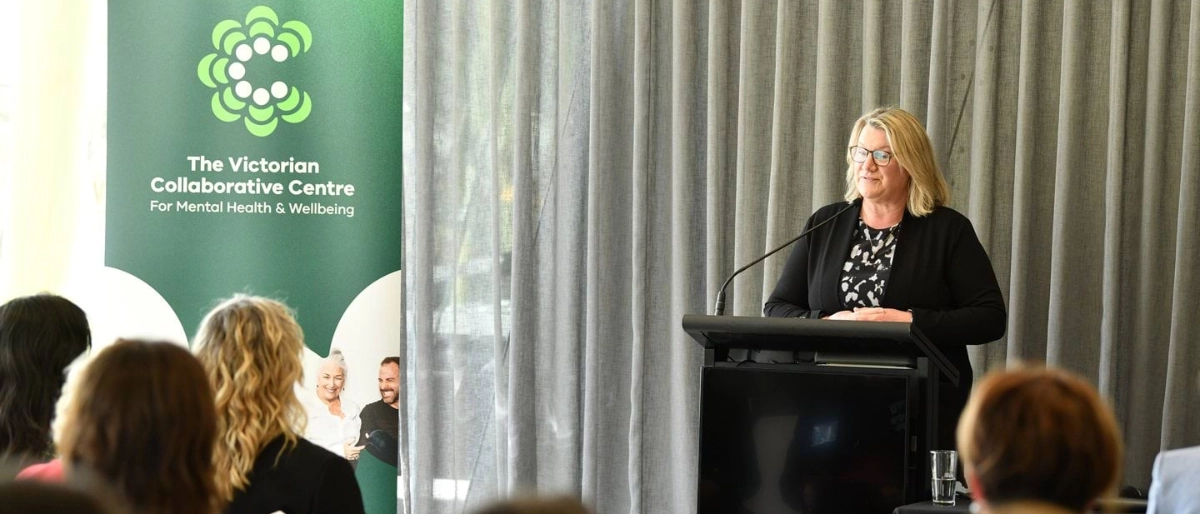
Our strategy was launched by Ingrid Stitt MP, Minister for Mental Health, who spoke about the role of the Collaborative Centre as an ‘engine room’ for system transformation.

Translational research projects

The Collaborative Centre funds a range of translational research projects.

Our Co-CEOs, Carolyn Gillespie and Professor Sarah Wilson, spoke about the significance of the strategy for delivering the Centre's ambition and new ways of working.

Carolyn spoke about the role of people with lived and living experiences as leaders and co-designers of the Centre's work, including the development of the Translational Research Strategy.

“We can harness this wisdom to lead the redesign and delivery of mental health and wellbeing services so that they are safe and responsive to our needs, and we can lead and participate in quality and ethical research that is implemented in practice for real and lasting change,” she said.

Sarah spoke about translational research as a core ingredient that has been missing from many levels of our mental health and wellbeing system. This includes the design and delivery of treatment, care and support, government decision-making and policy development, and supporting the wellbeing and capacities of our dedicated workforces.

"In our daily work, we need to pause and reflect on the evidence that underpins our thinking and practice in how we are delivering care,” she said.

“And where that evidence is lacking, commit to addressing that, to changing our practice, perhaps revisiting existing research or testing new ideas, and then sharing what works for the benefit of all Victorians."

The ambition of our Strategy is deeply human-centred, informed by the voices of people with lived and living experiences to guide us towards the solutions we need.

A heartfelt thank you to the many hundreds of contributors who helped shape this Strategy and who will be instrumental in driving real, lasting, and positive change for Victorians. We look forward to continuing this important journey in partnership with you.


Latest research

Community-based models of care facilitating the recovery of people living with persistent and complex mental health needs: a systematic review and narrative synthesis

This systematic review examined community-based mental health models supporting recovery for people with persistent, complex mental health needs. Analysing 59 studies across eight model types, researchers found promising evidence for intensive case management and integrated community treatment, but noted limited focus on personal recovery outcomes and insufficient consumer involvement in research design.

Victorian Suicide Prevention and Response Strategy 2024-2034

The Victorian suicide prevention and response strategy 2024-2034 outlines a 10-year whole-of-government approach to reduce suicide across all Victorian communities. Developed through extensive co-design with people with lived experience, it focuses on six priority areas: connected systems, strengthened supports, capable workforces, community action, government collaboration, and evidence-based delivery.

Mental Health and Wellbeing Act

The Mental Health and Wellbeing Act 2022 (Vic) is the primary piece of legislation with respect to mental health in Victoria and is the backbone of the regulatory framework for mental health. It is intended to ensure that Victorians obtain the highest standard of mental health and wellbeing and to reform the mental health system in accordance with the vision and recommendations of the 2021 Royal Commission into Victoria's Mental Health System.

Elimination of restrictive practices from acute adult mental health care services: A qualitative evidence synthesis of the lived experience literature.

This qualitative evidence synthesis explores the perceptions and experiences of mental health service users and practitioners regarding the use and proposed elimination of restrictive practices, such as seclusion and physical/mechanical restraint, in acute adult mental health care services.

The appropriateness of DUNDRUM-3 and DUNDRUM-4 for Maori in forensic mental health services in New Zealand: participatory action research

The Auckland Regional Forensic Psychiatry Services (ARFPS) in New Zealand has introduced structured clinical judgment instruments developed in Ireland (DUNDRUM-3 and DUNDRUM-4) to assist staff decision-making regarding service users’ clinical pathways. In New Zealand, Māori (the indigenous people) constitute 43% of the in-patient forensic mental health population. The aim of this study was to determine the face validity of the measures for Māori.